2017-32: Digital Warfare: The New Cold War

Earlier this week (14 Nov) Prime Minister Theresa May accused
Russia of “carrying out cyber espionage,” “meddling in elections” and trying to
"undermine free societies." She was addressing business leaders at the
Lord Mayor's Banquet
in London. Putin, she said, was "planting fake
stories" to "sow discord in the West". Russia could be a
valuable partner,Maysaid, but only if it "plays by the rules".
The following day (15 Nov) one of the UK's cyber-defence chiefs, Ciaran Martin, accused Russia of "seeking to undermine the international system" — over the past year it had “attacked Britain's media, telecommunications and energy sectors.” Indeed Martin, who is Chief Executive of the National Cyber Security Centre , revealed that his Centre (which was only set up a year ago) had already classed a total of 590 attacks — from a variety of perpetrators — as being "significant", and that more than 30 incidents had been judged serious enough to require a cross-government response.
He was speaking at an event organised by The Times
, which released
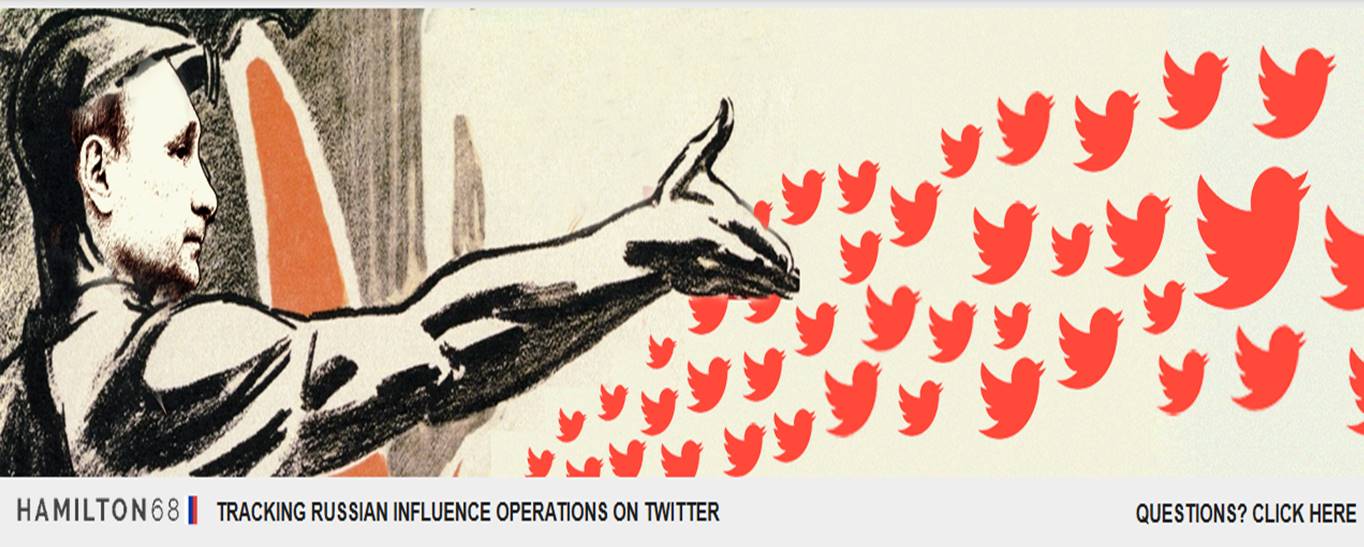
details of a new study into how Russia used Twitter to influence 2016's Brexit
referendum.This suggested that more than 156,000 Russia-based accounts,
many automated bots, mentioned #Brexit in original posts or retweets in the
days surrounding the vote.[The cartoon is from this article]
According to The Times, one account, Sveta1972, had shown itself to be “a voracious user of the social platform”, its architect, one ‘Svetlana Lukyanchenko’, had only signed up to Twitter in May 2016 — less than a month before Britain voted to leave the European Union. Svetlana “did not fit the profile of someone interested in British politics. Yet in the four days before the vote on June 23 she posted or retweeted at least 97 messages mentioning ‘#Brexit’. Her messages were mainly pro-Brexit and often repeated conspiracy theories. On June 21 she retweeted a story by the website Zero Hedge that said Britons were ‘appalled and disgusted’ by a Brexit postal ballot ‘fraud’. Later that day she tweeted that the EU was an ‘unelected assembly of corporatist agents’ imposing debt and austerity ‘on all member states’. After the vote she lost interest, confining her 12,000-plus tweets to subjects such as lighting design websites or free e-books on web traffic. Despite her Russian origins, most of her tweets were in English, Spanish or Italian.”
Responding to the Times report, the BBC’s Today Programme interviewed Jared Cohen, CEO of Jigsaw (formerly Google Ideas).* Cohen drew comparisons between cyber- and conventional warfare "Think about how high the threshold is for a state to engage in violence against another state; the threshold is much lower for nefarious cyber-attacks… If violence is how you destabilise the physical state, the distortion of truth and the disruption of the free flow of information is how a foreign actor would seek to collapse the digital side."
Jared said that "Fake news is the digital equivalent of what we're always thought of as propaganda. There's two other categories that don't get as much attention: one is when cyber bullies become better organised, better funded and state sponsored.” They use ‘patriotic trolling’, “the equivalent of taking key influences off the battlefield.” He said that Recep Tayyip Erdoğan uses this in Turkey to silence female journalists, he “activates trolling armies to hit [them] with dozens of rape threats every minute.” He said this is a highly effective tactic, and one that we are seeing governments around the world use. The third tactic he described was “the digital equivalent of paramilitary activity, when a foreign actor identifies the different interest groups, constituencies and parties in another country, combs social media for photos, looks for someone who would be a part of one of those interest groups or parties or constituencies, and then fabricates an identify around them… sometimes they'll spend months engaging in the conversation, building credibility and only at a certain moment decide to exacerbate the conversation.”
Worryingly we don’t as yet have “norms that govern how states respond to each other when attacked; you don't have deterrence in the cyber domain; you don't have doctrines of proportional response. Until states figure out what these norms look like you're going to have a rather chaotic geopolitical situation.”**
* The interview
runs from 07.21 for 7 minutes.
** Back in 2010, Cohen
co-authored an visionary paper
on ‘Digital Disruption’ with Google CEO’s Eric
Schmidt .
Another important paper on the topic appeared in Time Magazine
in March 2016, The
Unseen Threat of Digital Warfare. You might also like to look at four previous Blogs on this site, 31, 29, 27 and 23.